
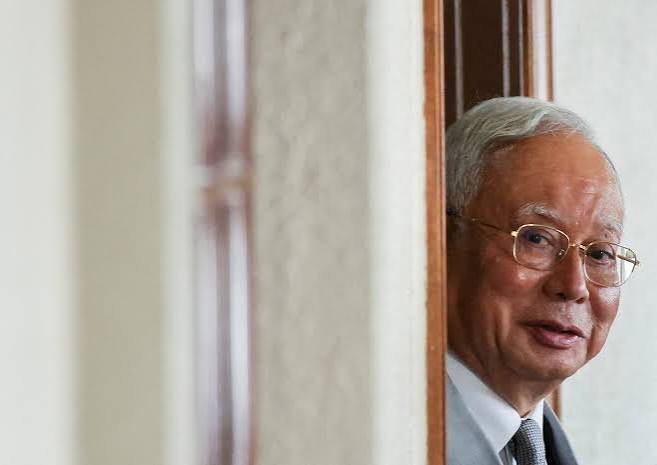
A Malaysian court has issued an order allowing former prime minister Najib Razak to serve the remainder of his sentence under house arrest, his lawyer said on Friday. Farhan Shafee told reporters that his team would deliver the order to Kajang prison, where Najib has stayed since 2022. He said Najib could return home later on Friday if officials complete the process as planned.
Najib, who served as Malaysia’s prime minister from 2009 to 2018, received a conviction in a corruption case linked to the multibillion-dollar 1Malaysia Development Berhad (1MDB) scandal. He helped establish the state investment fund while in office but has consistently denied wrongdoing. Malaysia’s King Sultan Ibrahim agreed in September to let him serve the remainder of his sentence at home, according to the report.
The royal pardon required Najib to pay a fine of 50 million ringgit, equivalent to around $12.32 million. His party, the United Malays National Organisation (UMNO), said it had paid the amount on his behalf. The party raised the money through crowdfunding after Najib’s lawyers said frozen bank accounts prevented him from paying the fine himself.
The 1MDB scandal involved allegations that billions of dollars disappeared from the state fund. US investigators estimate that a scheme involving the fund diverted as much as $4.5 billion. More than $1 billion allegedly reached accounts linked to Najib. He has described himself as a scapegoat in the complex international scandal. In a separate 1MDB-related case, a court convicted him in December last year and sentenced him to 15 years in prison. It also imposed a fine of $2.8 billion for abuse of power and money laundering.
Najib has appealed that separate conviction. His lawyers asked the court to suspend his prison term and fines while the appeal proceeds. They cited his declining health and inability to pay the large penalty. However, a judge rejected the request last month. The judge said the case involved no special circumstances and stressed the public interest in the seriousness of the offence.
Najib remains influential within UMNO, which forms part of Prime Minister Anwar Ibrahim’s coalition government. However, Anwar’s Pakatan Harapan alliance has strongly opposed leniency for the former leader. A move to house arrest could therefore deepen tensions within the governing coalition. Although Malaysia does not expect its next general election until early 2028, Anwar has said he could call an early vote if political divisions worsen.
Former lawmaker Tony Pua, who helped draw attention to the 1MDB scandal, criticised UMNO’s fundraising effort. In a Facebook post, he accused the party of prioritising Najib over ordinary Malaysians. His comments reflect the continuing public debate over Najib’s treatment and the wider consequences of the 1MDB scandal.